⌁
Agricultural knowledge
Document the practice, crop, season and observed outcome. Preserve the difference between a farmer’s experience, a research finding and an untested hypothesis.
 KishKam Robotics LabRegister pilot interest ↗తెలుగు
A recommendation is only as useful as its evidence and context. KishKam’s research connects farmer observations, traditional practices and scientific findings while keeping their sources and limitations visible.
Document the practice, crop, season and observed outcome. Preserve the difference between a farmer’s experience, a research finding and an untested hypothesis.
Investigate sensing, navigation and multi-agent coordination around defined agricultural tasks and realistic operating conditions.
Use consented observations and appropriately designed trials to evaluate usefulness. Record uncertainty and negative results alongside promising findings.
Can a diary preserve enough field and activity context to support useful questions later?
The prototype has field and diary screens. Authentication endpoints and database migrations have passing development tests. Connecting the complete farmer workflow is still in progress.
Screen designs and software tests do not demonstrate farmer adoption, improved yields or field readiness. Those questions require pilot feedback and documented evaluation.
We evaluated a core three-stage record workflow in the KishKam Field prototype: field profile initialization, daily activity entry (sowing, irrigation, inputs, pest observations), and local-first data caching.
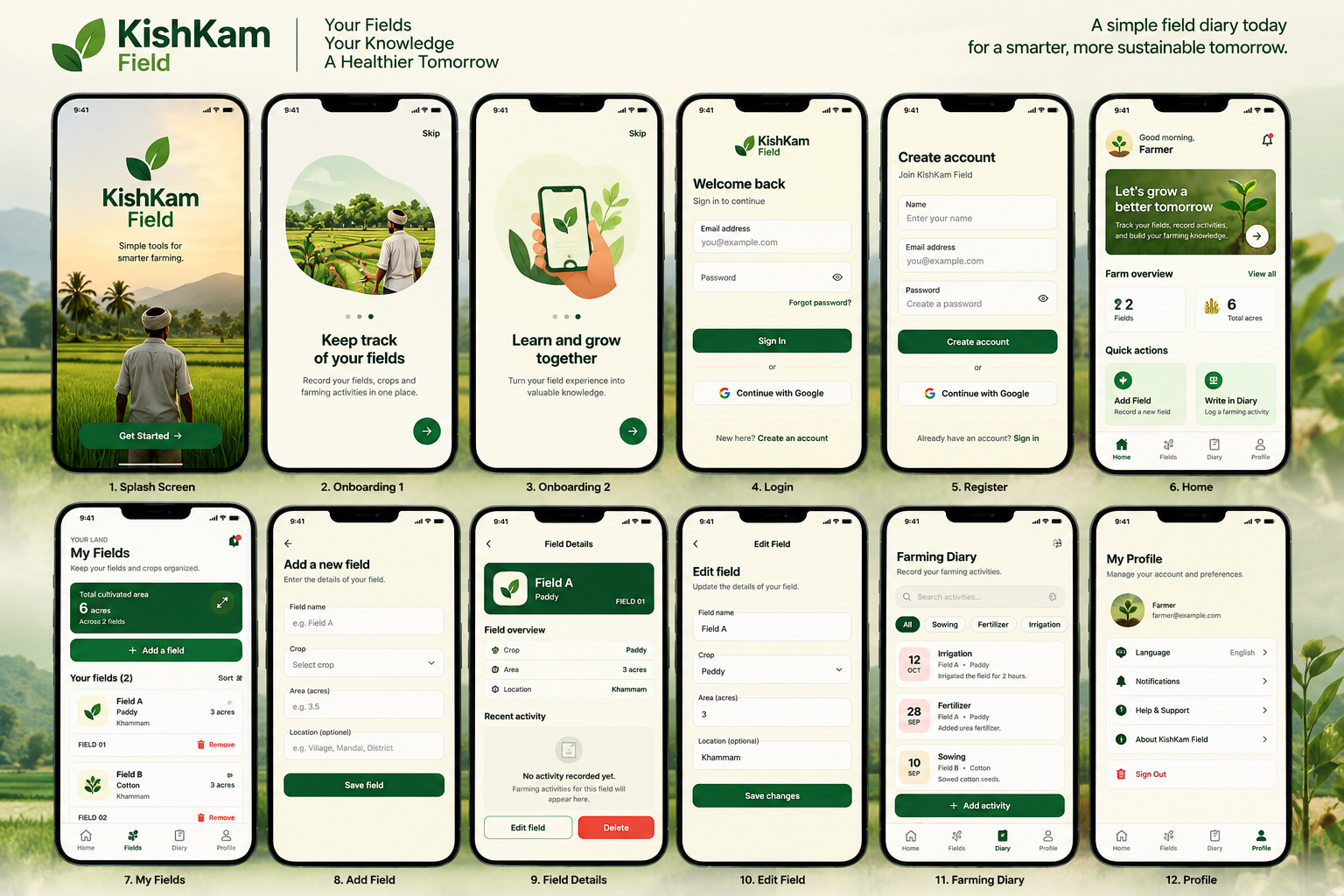
Local in-memory and SQLite records allow immediate entry without network delay. Sowing and irrigation logs capture date, crop type and field association reliably in test environments.
Testing is currently limited to development emulators and simulated records. Sync conflict resolution under intermittent rural connectivity has not been field-tested. The prototype does not yet provide agronomic validation, yield predictions, or spray advice.
Conduct structured usability sessions with 5–10 farmers to measure data entry completion rates, Telugu text readability, and offline synchronization stability under actual rural network constraints.
Future research notes will explain the question, method, source and limitations—not just the result. Publications and engineering demonstrations will carry clear attribution; field findings will appear when there is evidence to report.
Interested in collaborating on agricultural research, field trials, or intelligent automation? Start a conversation →